Teacher resource · IELTS Speaking

Teach IELTS Speaking for real, confident communication.

A practical guide for turning the IELTS Speaking test into teachable communication skills. Plan lessons around the public assessment criteria, teach Parts 1–3, build useful practice, and give feedback learners can act on.

Complete teacher guide 90-minute online lesson plan Updated 23 September 2026
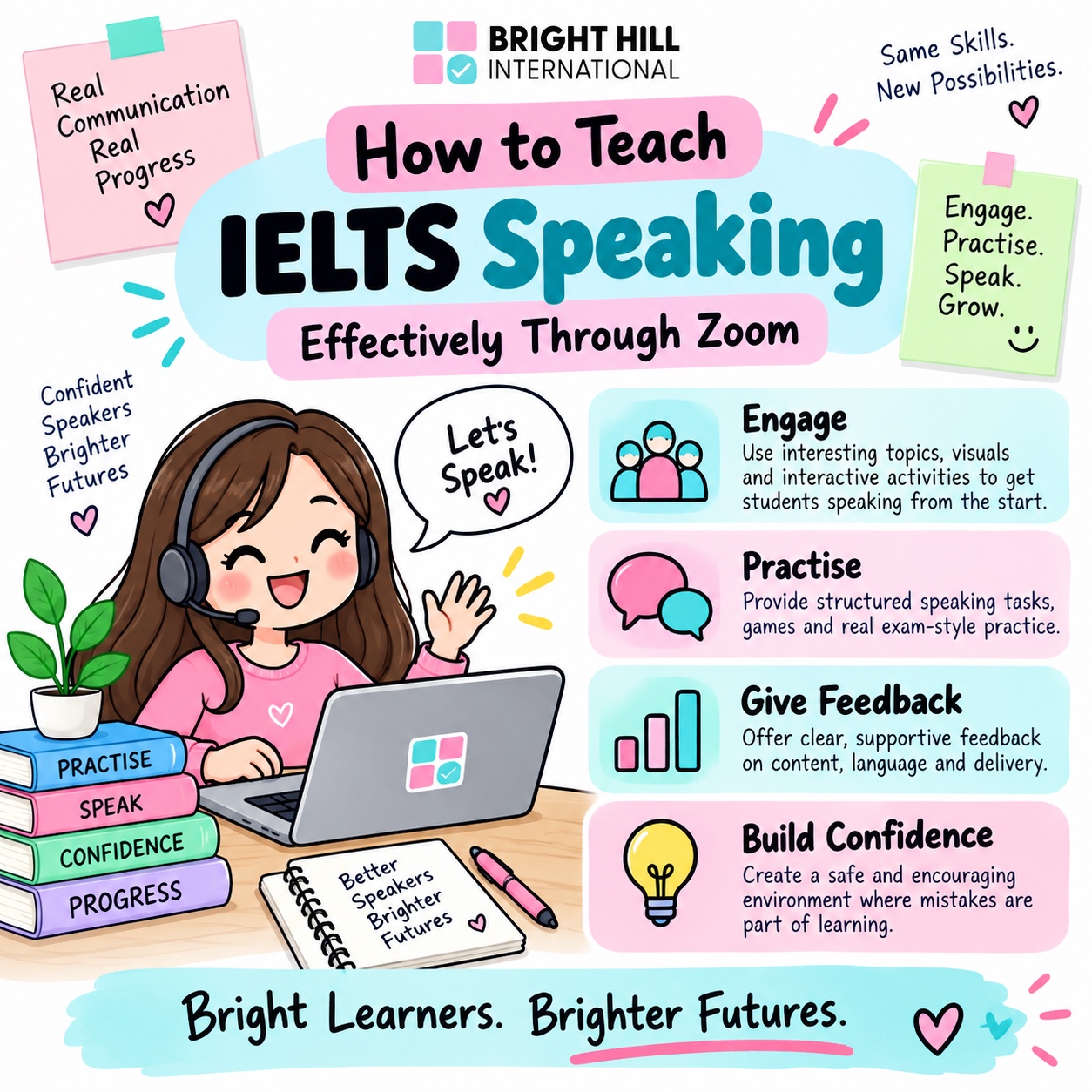
Bright Hill International poster introducing an IELTS Speaking teaching cycle: engage, practise, give feedback, and build confidence.
Start with the whole teaching cycle.Open full poster
11–14 minOfficial total speaking-test time
3 partsIntroduction/interview, individual long turn, discussion
4 criteriaFluency, vocabulary, grammar, pronunciation
Equal weightEach criterion contributes equally to the Speaking score

Jump to a section

01 · Start with the construct

Teach the speaking ability the test is designed to hear.

IELTS Speaking assesses spoken English through a live interview. The Speaking test has exactly three parts—there is no Part 4—and is used in both Academic and General Training IELTS. Build learners’ ability to communicate naturally and develop ideas instead of rehearsing scripts.

Plan backwards

Choose a visible performance goal.

Write a lesson outcome learners can demonstrate: “I can organise a one-minute plan and speak clearly about one specific example for up to two minutes.” Avoid goals such as “learn Band 7 vocabulary” without an observable speaking behaviour.

Teach one priority

Turn criteria into small skills.

Start with a short speaking sample. Choose the barrier that most affects communication, such as undeveloped examples, repeated vocabulary, unclear sentence stress, or long pauses while searching for ideas.

Practice, notice, retry

Make feedback lead to another attempt.

Teach or model one strategy, let learners use it, give evidence-based feedback, and provide a new opportunity to speak. Improvement needs repeated performance, not a list of corrections.

Keep it communicative

Use meaningful prompts and real listeners.

Pair and group work gives learners more speaking turns. The teacher listens for evidence and coaches; the teacher should not be the only person each learner speaks to in every practice round.

Keep the goal realistic. A classroom activity can practise skills that transfer to IELTS, but it is not itself an official test and one short recording cannot guarantee a band score. Use the public band descriptors as a shared learning reference.

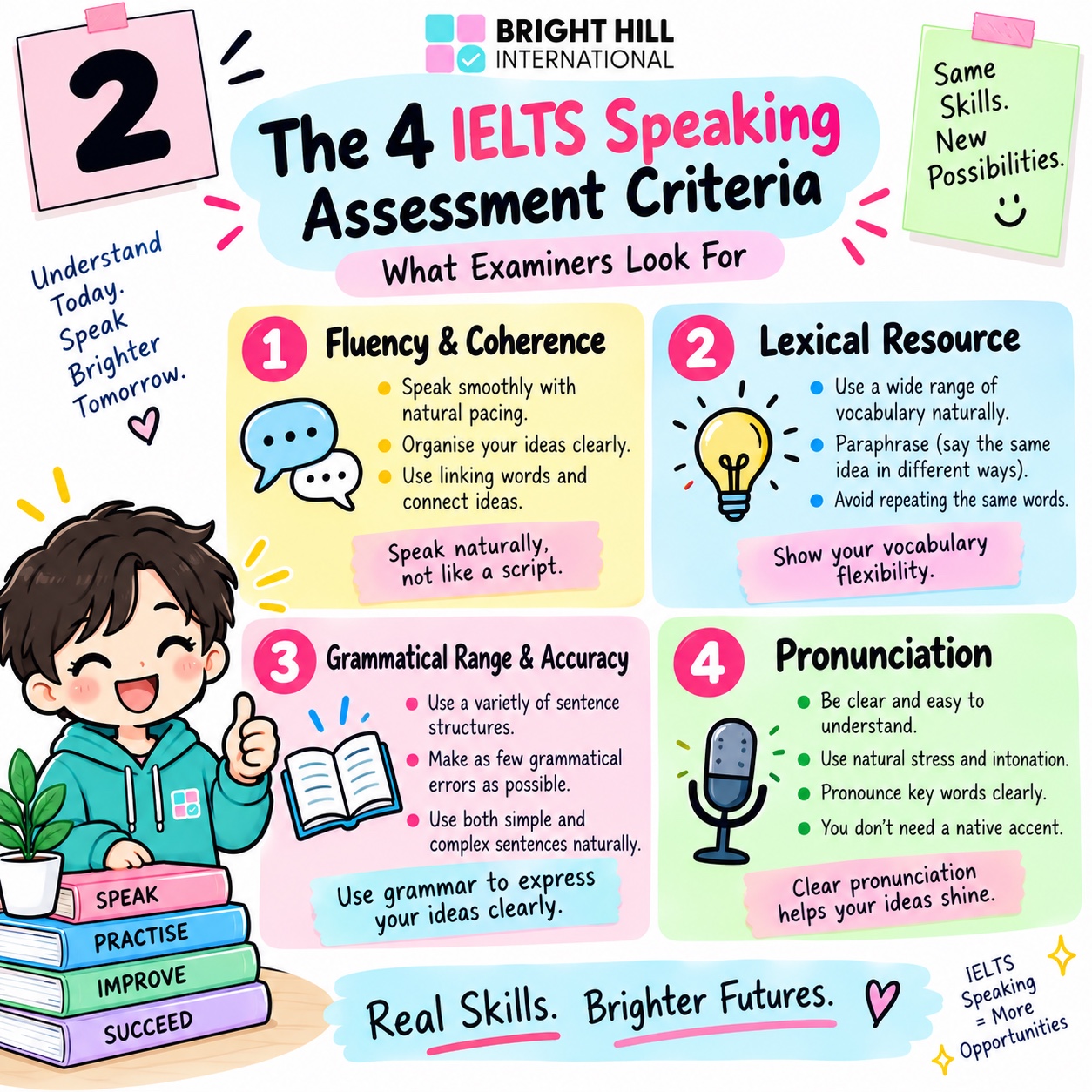
Bright Hill International poster summarising Fluency and Coherence, Lexical Resource, Grammatical Range and Accuracy, and Pronunciation.
Use the criteria to guide practice and feedback.Open full poster
02 · Teach the four criteria

Make the scoring language observable.

The four criteria are equally weighted. Explain them in learner-friendly language, then point to evidence in what the learner actually said. A sophisticated word or a complex sentence does not compensate automatically for unclear meaning elsewhere.

Fluency & Coherence

Listen for continuity, a manageable pace, relevant ideas, logical sequencing, and links that help the listener follow. Fluency is not speaking as fast as possible.

Teach: pause between ideas, signpost a point, and extend an answer with a reason or example.

Lexical Resource

Listen for vocabulary that is varied, precise, appropriate to the meaning, and flexible when a word is missing. Repetition matters when it limits expression.

Teach: topic collocations, paraphrasing, word families, and explaining around a missing word.

Grammatical Range & Accuracy

Listen for both the range of structures and how accurately and appropriately the learner uses them. Longer is not automatically better.

Teach: combine clauses, use time references clearly, and make complex forms serve the message.

Pronunciation

Listen for intelligibility and the use of pronunciation features to communicate meaning. Accent imitation is not the objective.

Teach: thought groups, word and sentence stress, key sounds, connected speech, and listener-friendly pace.

Teacher move: give one specific example before a label. “Your main point was easy to follow because you used ‘the main reason is…’” is more actionable than “Your coherence is good.”

03 · Build a repeatable lesson

Use a cycle that moves learners from input to independent speaking.

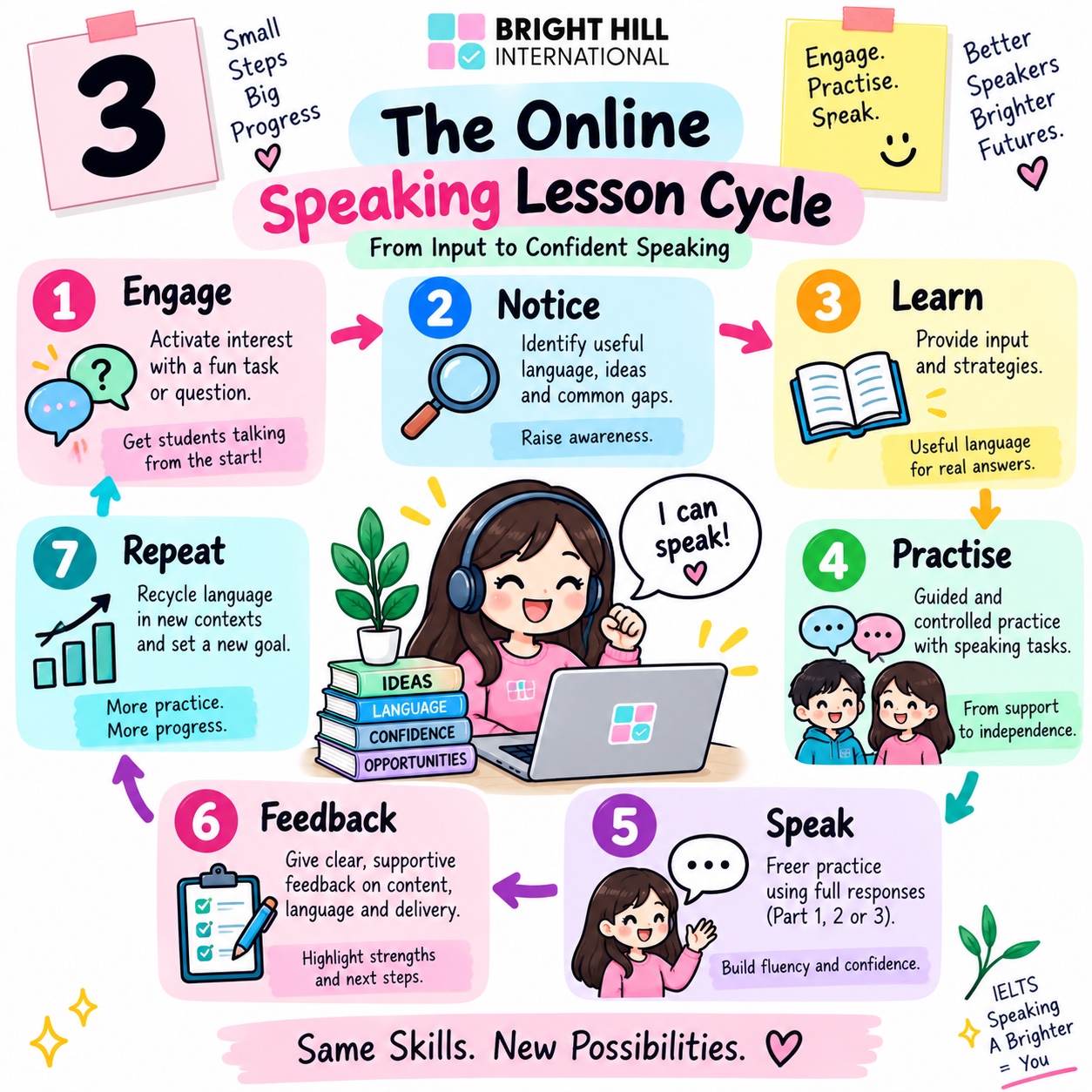
A strong speaking lesson does not need to lecture about every criterion. A short, connected cycle keeps students speaking while giving the teacher clear evidence to respond to.

1 · Engage

Start with a quick opinion, image, choice, or question that gets everyone talking.

2 · Notice

Use a short learner sample or model to identify one useful feature and one gap.

3 · Learn

Explain one strategy or language resource and show it in context.

4 · Practise

Run a guided task with a prompt, model, planning time, or useful language bank.

5 · Speak

Give learners a new attempt with less support and a real listener.

6 · Feedback

Share a strength and one specific next step tied to evidence.

7 · Repeat

Let the learner use the feedback in another short turn or a parallel prompt.

Example: if learners hesitate because they have no ideas for a Part 2 cue card, first teach fast idea generation and keyword notes. Do not spend that lesson correcting every article, tense, and sound at once.

Bright Hill International poster showing an online speaking cycle: engage, notice, learn, practise, speak, feedback, and repeat.
A full cycle for a live online speaking lesson.Open full poster
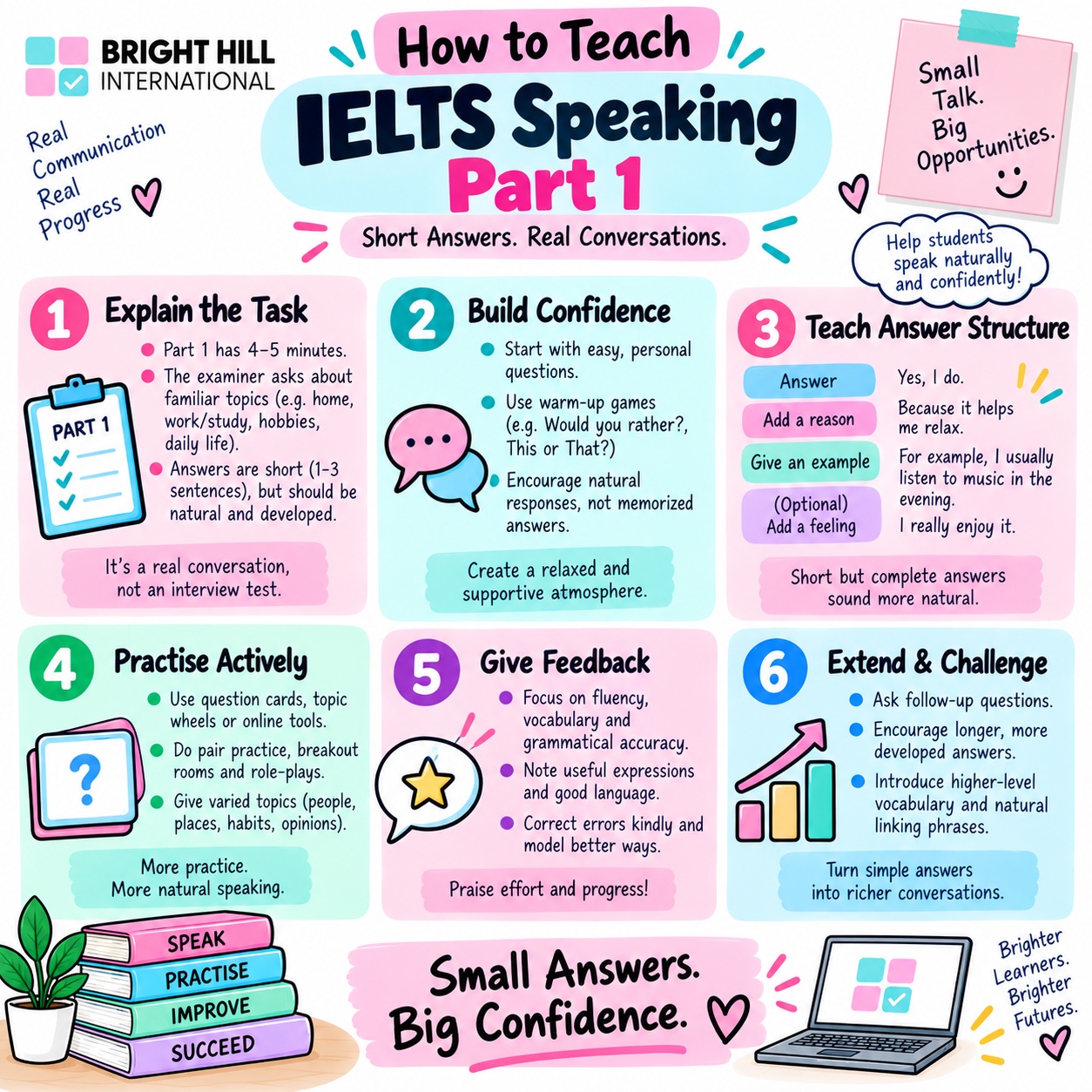
Bright Hill International poster on teaching IELTS Speaking Part 1: explain the familiar-topic interview, build confidence, structure a natural response, practise, give feedback, and extend.
Part 1: short answers, real conversation.Open full poster
04 · Part 1

Help learners answer familiar questions naturally.

Part 1 is an introduction and interview about familiar areas such as home, work or study, interests, and everyday life. It lasts about four to five minutes. Teach learners to answer the question directly and add a relevant detail without turning a simple question into a speech.

Practice question: “What do you enjoy doing at weekends?”

“I usually go for a long walk on Sunday mornings. It helps me reset after a busy week, and I sometimes take my camera along.”

The answer above is a demonstration of development, not a script to memorise. Learners should be able to personalise the idea and respond if the examiner asks a follow-up.

A simple practice progression

  1. Ask a familiar question and let learners answer once without interruption.
  2. Have them notice whether they answered the question and added a reason, detail, or example.
  3. Teach one useful extension strategy, then practise in rotating pairs with new questions.
  4. Ask a natural follow-up question and let learners adapt their answer.

Watch for: memorised paragraphs, answers that are only “yes” or “no,” and answers that continue after the point is complete. Teach flexible support, not a mandatory number of sentences.

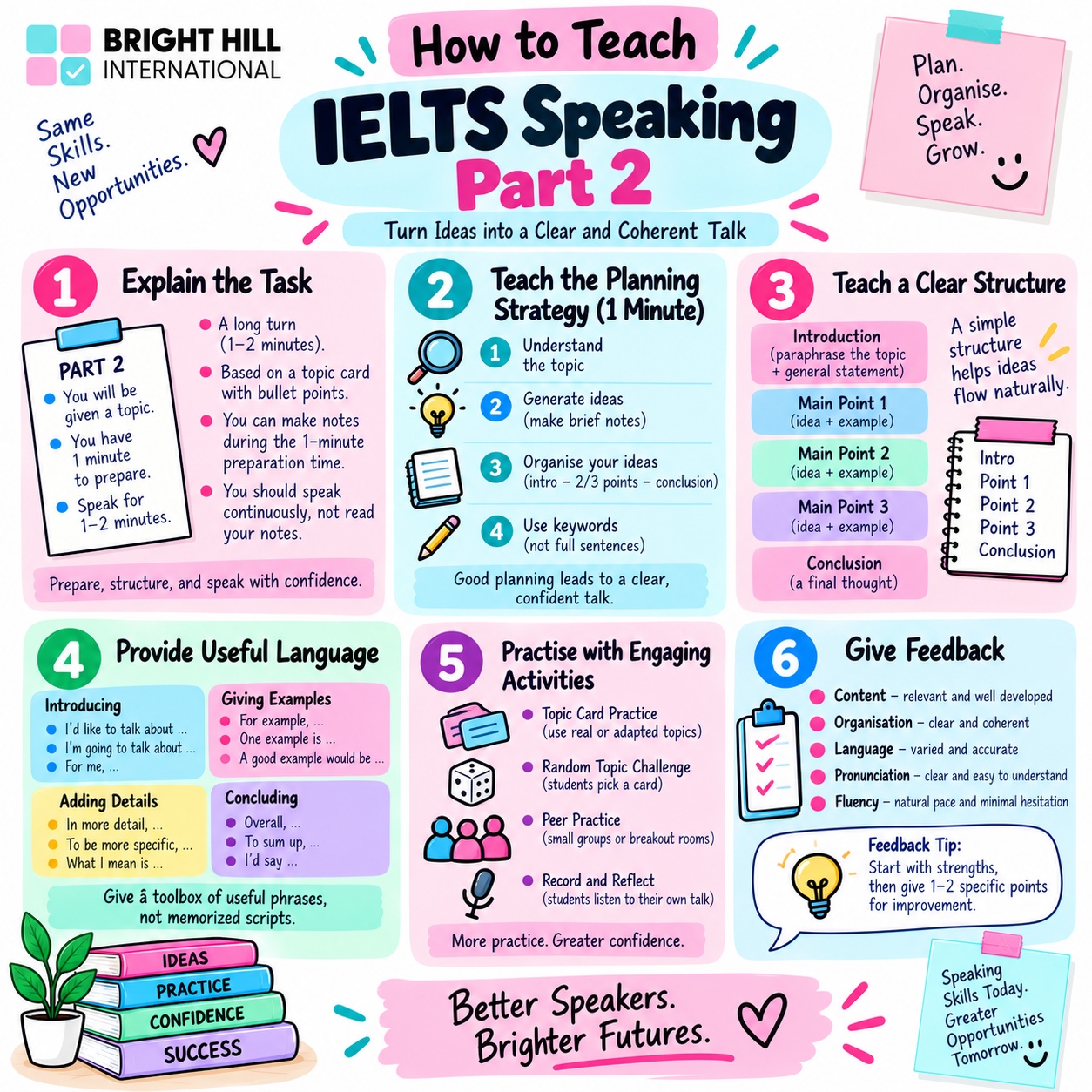
05 · Part 2

Teach a one-minute plan that supports a two-minute talk.

In Part 2, the learner receives a topic card, has one minute to prepare, and speaks for one to two minutes. The task is an individual long turn. Learners may make brief notes; teach them to use notes as prompts rather than reading full sentences.

Model a flexible planning routine

  1. Understand the task: underline the person, place, event, object, or experience to describe.
  2. Choose one specific example: a concrete memory is easier to develop than several unrelated ideas.
  3. Make keyword notes: jot a few prompts for context, details, feelings, and why it matters.
  4. Put the notes in an order: choose a route that fits the prompt; it may be a timeline, comparison, or description.
  5. Speak to a listener: connect the bullet points naturally and explain details rather than reading them aloud.

Teacher-created practice prompt — not an official IELTS question

Describe a skill you learned that has been useful to you.

Learner notes: cooking · aunt showed me · first flat · burnt first batch · practise on Sundays · now cook for friends.

After the first attempt, ask the learner to identify where the talk became thin or repetitive. Give a focused next step, then use a different cue card to check whether the planning strategy transfers.

Bright Hill International poster on IELTS Speaking Part 2: understand the cue card, plan with keywords in one minute, organise a long turn, practise, and receive feedback.
Part 2: plan, organise, and speak.Open full poster
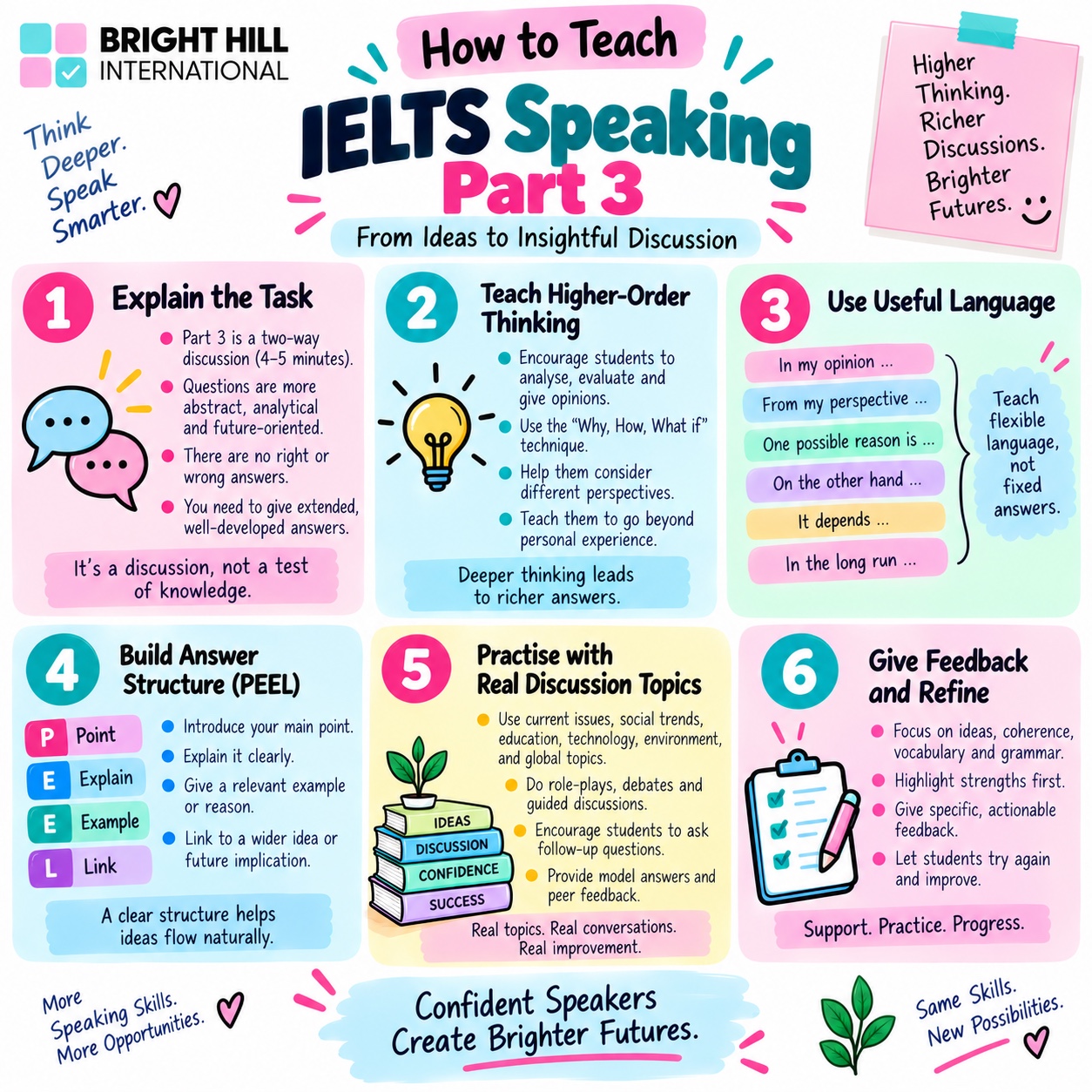
Bright Hill International poster on IELTS Speaking Part 3: develop opinions, analyse broader ideas, use flexible language, practise discussion, and refine with feedback.
Part 3: move from personal examples to broader ideas.Open full poster
06 · Part 3

Build discussion skills, not memorised opinions.

Part 3 is a two-way discussion connected to the Part 2 topic. Questions are usually broader and invite learners to explain, compare, speculate, or consider reasons and consequences. It lasts about four to five minutes. The examiner is evaluating spoken English, not testing specialist knowledge or whether the learner agrees with a particular view.

Give learners a flexible idea path

Position → reason → example → implication or qualification. This is a planning option, not a compulsory formula. Learners can choose another clear route that fits the question.

State a view

“In my view…”
“I would say that…”

Explain why

“One reason is…”
“That tends to happen because…”

Qualify or compare

“It depends on…”
“Compared with the past…”

Use questions that deepen the discussion

  • Why might people choose to learn practical skills outside school?
  • How has technology changed the way people learn new skills?
  • Should employers provide more training for adults?
  • Do you think the skills people need will change in the future?

Coach beyond personal stories. If a learner answers every question with a private anecdote, prompt them to connect the example to a broader pattern, a group, or a possible future change.

07 · Ready-to-teach lesson

90-minute online lesson: “A skill I learned”

Use this sequence with a live class on Zoom or another video platform. It practises all three parts through one theme while keeping the main learning focus on idea development and clear speaking.

Learning outcomes: by the end of the lesson, learners can (1) extend a Part 1 answer with a relevant detail, (2) make keyword notes in one minute and organise a Part 2 long turn, and (3) give and support an opinion in a Part 3 discussion. Use one outcome as the priority if the class needs more time.

TimeStage & purposeTeacher and learner procedureEvidence to notice
0–6 minEngageDisplay “What is something useful you learned recently?” Learners share one idea in chat or pairs; invite two examples without correcting yet.Who can find an idea quickly? Which examples are easy to explain?
6–14 minBaseline Part 1Ask two familiar questions about learning and free time. Learners answer in pairs; each listener notes one clear detail and one place the answer could develop.Relevance, continuity, and how the learner supports an answer.
14–24 minNotice a modelShare a short model answer. Learners identify the direct answer, reason, and specific detail. Briefly connect evidence to Fluency and Coherence and Lexical Resource.Can learners explain what helps the listener follow?
24–34 minTeach one micro-skillModel a flexible Part 1 extension: answer first, then add one reason, detail, or example. Learners improve one short answer and personalise it.Meaningful development rather than extra words or memorised phrases.
34–48 minPlan Part 2Give the teacher-created cue card “Describe a skill you learned that has been useful.” Model a 60-second keyword plan; learners plan privately, then compare the order of their notes.Keywords, one specific example, and a clear route through the talk.
48–59 minFirst long turnIn pairs or trios, learners speak for up to two minutes. Listeners use one assigned focus: coherence, vocabulary, grammar, or pronunciation. Rotate roles when possible.Whether the learner develops the cue-card points and stays understandable.
59–69 minFeedback clinicAsk each speaker what worked. The listener gives one evidence-based strength and one next step; the teacher models a useful language or organisation choice from anonymous notes.Feedback is specific, respectful, and linked to a next action.
69–80 minPart 3 discussionUse “Opinion Ping-Pong”: “Should schools teach more practical skills?” Learners build on or challenge a partner’s view with a reason and example. Swap roles after several turns.Responsive listening, reasons, examples, and broader ideas.
80–87 minRetry with transferGive a parallel question or a new cue card. Learners retry the one skill they selected, then compare their new performance with the first attempt.Use of the strategy on a fresh prompt, not memorisation of the old answer.
87–90 minExit ticketEach learner writes or says: “One thing I did well… / My next speaking goal… / I will practise by…” Set a short voice-note task.A clear, learner-owned next step.

Teacher preparation: a timer, one cue card, two Part 1 questions, three Part 3 prompts, a simple observer checklist, and breakout pairs or trios. Record learners only when they agree and when the recording has a clear learning purpose.

08 · Make practice active

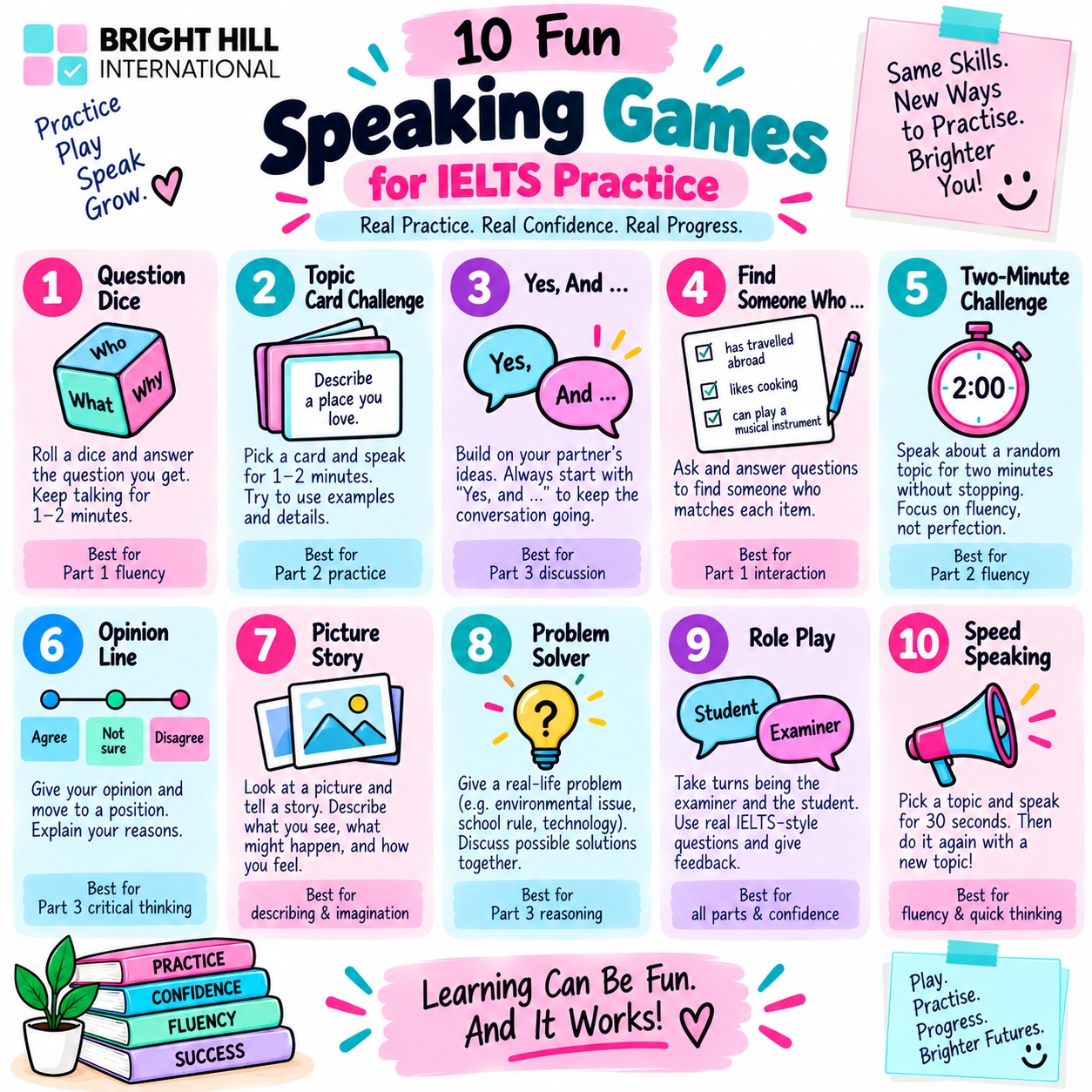
Ten speaking activities with a teaching purpose.

Games work when the speaking goal is clear and every learner gets a turn. Keep the activity short, demonstrate it, and finish with a reflection or retry. Some activities below practise transferable skills rather than copy an IELTS task.

01

Question Dice

Roll “Who / What / Why / How” prompts, then answer a familiar question. Add a reason or one example.

Part 1 · quick responses
02

Topic Card Challenge

Pick a cue card, plan with keywords, and speak for one to two minutes. Listeners note one strong detail.

Part 2 · planning and coherence
03

“Yes, and…”

Partners build on an idea with a relevant addition. Later, let them disagree politely or qualify the point.

Part 3 · interaction and extension
04

Find Someone Who…

Learners circulate or use breakout rooms to find classmates matching a prompt, then report one detail they learned.

Part 1 warm-up · follow-up questions
05

Two-Minute Challenge

Speak on a concrete topic for up to two minutes. Repeat with a new topic, aiming for clearer development, not speed.

Part 2 · continuity
06

Opinion Line

Choose agree, unsure, or disagree. Learners explain their choice and respond to a different position.

Part 3 · reasons and qualification
07

Picture Story

Describe what is visible, infer a possible sequence, and explain the inference. Use this as general fluency practice, not an IELTS Speaking task simulation.

Vocabulary · narrative coherence
08

Problem Solver

Discuss a realistic problem, compare options, and justify a solution. Ask learners what might change the decision.

Part 3 · evaluation and comparison
09

Role Play

Take turns asking and answering a familiar question, then switch partners. Use it as a confidence-building interaction task, not an exact examiner script.

Warm-up · responsive speaking
10

Speed Speaking

Give learners 30 seconds to organise an idea, speak briefly, and try again on a fresh prompt. Prioritise clear ideas over fast speech.

Fluency · quick idea generation
Bright Hill International poster listing ten speaking games: Question Dice, Topic Card Challenge, Yes And, Find Someone Who, Two-Minute Challenge, Opinion Line, Picture Story, Problem Solver, Role Play, and Speed Speaking.
Ten ways to create more practice turns.Open full poster
09 · Discussion routine

Use Opinion Ping-Pong to practise responsive discussion.

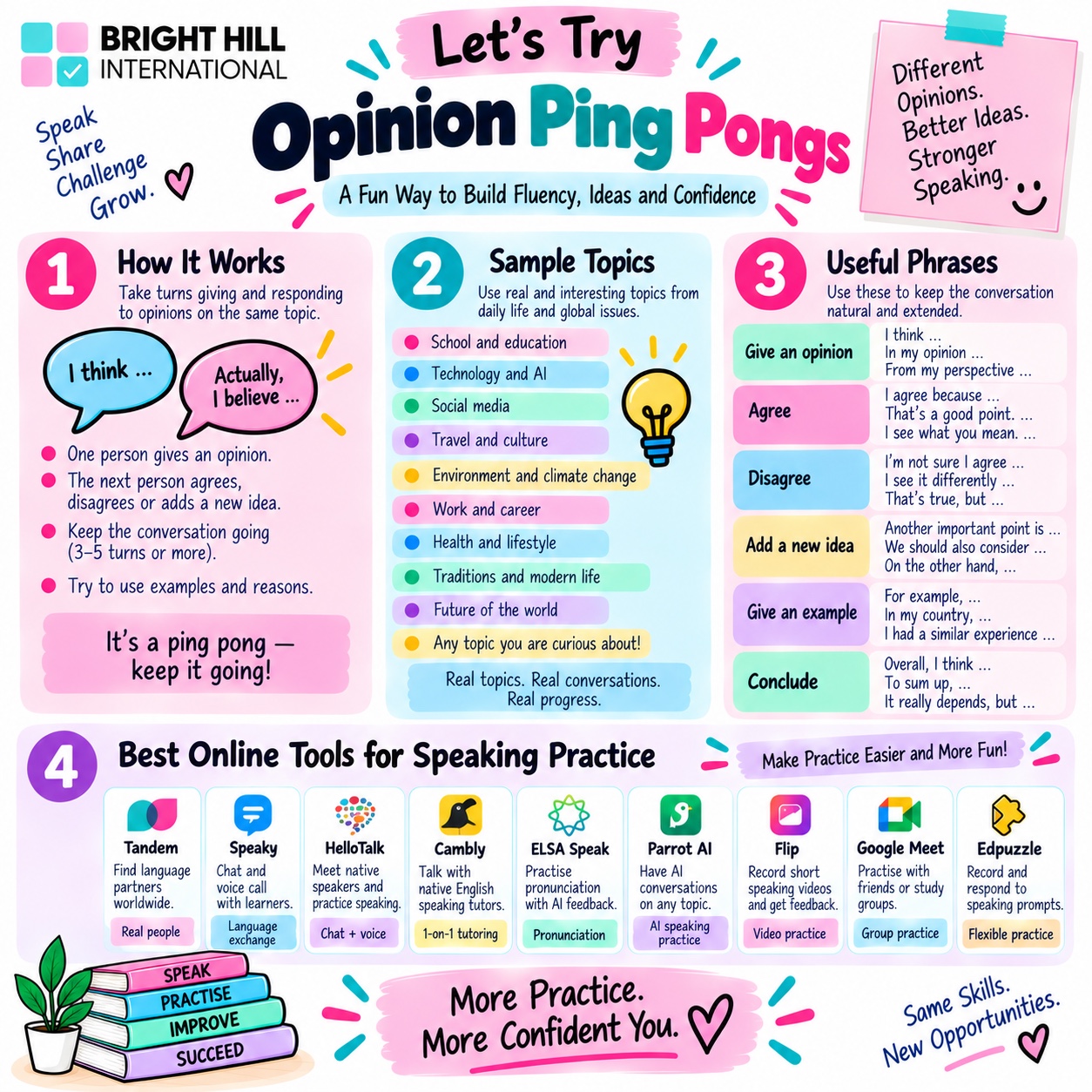
Opinion Ping-Pong is a classroom routine for keeping an exchange going. It helps learners practise listening, taking a position, adding reasons and examples, and responding to an idea. It is practice, not an IELTS scoring formula.

1 · Offer a view

“I think public transport should be cheaper.”

2 · Respond

“I see your point, but…” or “I agree because…”

3 · Support it

Give a reason, relevant example, or consequence.

4 · Keep listening

Ask a follow-up, add a new angle, or qualify your view.

Run at least three exchanges before switching roles. After the game, ask learners which turn showed active listening and which phrase helped them express a more precise view.

Agree and add

“That’s a good point. I’d also add…”

Disagree politely

“I see it a little differently because…”

Give an example

“For instance, in my experience…”

Choose online tools by the speaking job.

Tools should create useful speaking turns or feedback. The following names are examples printed on the supplied poster; check each service’s current availability, privacy options, terms, and age requirements before using it with students.

Practice goalExamples from the posterTeacher use
Conversation with other speakersTandem, HelloTalkSet a narrow question, a short speaking goal, and a reflection task; do not ask learners to share private contact details.
Tutor-led conversationCamblyPrepare follow-up questions and one feedback focus before the conversation.
Individual speaking practiceSpeakly, ELSA Speak, Parrot AIUse short practice prompts, then have learners check whether feedback is understandable and relevant.
Live pair or group lessonGoogle MeetUse the meeting room for timed pair turns, teacher modelling, and a whole-class feedback clinic.
Video or prompt-based responseFlip, EdpuzzleSet a short, specific spoken response and explain who can view or keep a recording.

Tool-selection rule: choose the simplest option that meets the lesson goal. Give learners a non-recorded alternative when audio or video sharing is not appropriate.

Bright Hill International poster showing Opinion Ping-Pong, sample discussion topics, useful phrases, and online speaking-practice tool names.
Discussion prompts and tool ideas.Open full poster
10 · Make feedback useful

Give feedback learners can use on their next turn.

Speaking feedback should support communication and accuracy. A short, repeatable cycle helps learners understand what worked, select a manageable priority, and try again.

1 · Self-notice

Ask: “What part of your answer was easiest to follow? Where did you pause or lose your idea?”

2 · Share evidence

Name a specific phrase, example, pause, stress pattern, or point in the recording.

3 · Set one next step

Choose one change that is realistic for this learner and this task.

4 · Retry

Give a new attempt or a parallel question so learners can apply the advice.

Content & development

Did the answer address the question? Did it include a relevant reason, detail, example, or explanation?

Organisation

Could a listener follow the order of ideas? Did linking language make the relationship between ideas clear?

Language

Which words or structures expressed the meaning accurately? What could be varied or repaired?

Delivery

Was the message easy to understand? Did pace, pausing, stress, or intonation help the listener?

Correction choices: during controlled practice, pause and guide learners to self-correct. During a fluency turn, note recurring issues and discuss them afterwards so correction does not interrupt every idea. Praise effort and progress, then give a specific next step.

11 · Match the task to the class

Keep every learner speaking, whatever the group size.

Set a clear task, rotate roles, and make the teacher’s monitoring plan visible. If you cannot hear every pair, assign listeners a narrow focus and collect an exit reflection from everyone.

One-to-one

Model, switch roles, retry.

Begin with a short learner turn. The teacher models a response or asks follow-ups, then the learner tries again with a new prompt. Use one criterion at a time and agree before recording.

Pairs & trios

Rotate speaker, listener, observer.

Give each observer one criterion to monitor. Rotate roles after each prompt so both learners speak and hear focused feedback.

Larger groups

Use rounds and shared checklists.

Start in pairs, then regroup for a short demonstration or feedback clinic. Assign breakout-room tasks, use visible timers, and invite a few learners to share examples.

Online setup: put the task and timing on screen, give a clear start signal, keep instructions short, and tell learners what the listener should notice. Ask permission before recording or sharing learner audio.

12 · Build practice between lessons

Use short, spaced speaking tasks—not a pile of full mock tests.

Keep the independent workload small enough to complete. Have learners save one useful piece of evidence from each practice task and bring it to the next lesson.

A

Part 1 voice note

Answer three familiar questions. Listen once and choose one answer to develop with a clearer detail.

B

Part 2 keyword plan

Plan one teacher-created cue card in one minute. Keep only keywords; then speak and self-check one criterion.

C

Part 3 opinion exchange

Record a two-person discussion or practise with a partner. Respond to a view before adding your own example.

D

Reflection

Write one evidence-based strength and one next action. Compare with the previous week rather than judging from memory.

13 · Further reading

Use authoritative sources to keep lessons accurate.

The practical teaching routines here are original guidance informed by the public IELTS format and assessment resources, plus British Council TeachingEnglish resources on speaking, monitoring, and feedback. Check official resources for future test updates.

Choosing online tools: the names shown in the accompanying poster are examples from the original visual, not a guarantee that every platform is currently available or suitable. Before assigning a tool, check its current access, age requirements, pricing, privacy settings, and recording options.